Freaks & Outlaws

Had a relaxing week in Toronto and spent a lot of time looking at the skyline, water and sunsets.


IMG_1204 IMG_1210

One day, we wandered around the entertainment district and discovered Queer Outlaw Cinema – a free exhibition running until August 17th at TIFF.

Featuring Derek Jarman, Isaac Julien, Scott Treleaven, Ulrike Ottinger and Bruce LaBruce.

This year marks the 20th anniversary of the death of Derek Jarman, a British filmmaker, artist and activist who was outspoken in his fight against the (anti-gay, etc) policies of Margaret Thatcher. The exhibition features one of his super 8/experimental films, Imagining Octobera dreamlike meditation on art and politics in the final years of the Cold War.

Imaging October is a mixture of images and film clips interspersed with politically tinged slogans. For example:

English bobbies in the street
protect the rights of them they beat.

Dungeness by Isaac Julien and Picture Yourself In A Burning Building by Scott Treleaven were inspired by Jarman’s technique (tributes to him, really) but, for me, lacked the “rebel” edge of the other exhibits. Both Julien and Treleaven have done work which would have better fit an outlaw narrative.

Superbia Still
Still from Superbia

The best part of QOC was being introduced to the work of Ulrike Ottinger. First we saw a short film, Superbia – The Pride (1986) – a political procession that is part parade, part military exercise and all corruption. One of my favorite (translated, of course) lines: “Only the banks can survive hari-kari.”
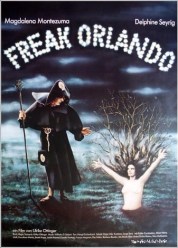
20140709-203620-74180929.jpgInspired by Virginia Wolff’s Orlando, Freak Orlando traces the journey of the main character’s reincarnation and transformation through 5 points in history. There are lots o’ themes present:

  1. Outsider as side show attraction, for the amusement of others
  2. Outsiders relegated to a certain place in society or face destruction if they refuse to play the role.
  3. The attempt to annihilate outsiders through assimilation
  4. Outsiders living together in community–you’d think it would be a paradise but the effect of repression/suppression is there (with a tip of the hat to Todd Browning’s Freaks).
  5. What does it mean to be accepted/integrated into society if it’s the same establishment (who is still making the rules). Even in “freak positive” world the deck is still rigged…
  6. And lot’s more- sacred shopping! the bearded woman nailed to the cross! the self-flagellating army of leather clad Tom of Finland types! Outlaw beard stroking!
  7. This movie is just ripe for film analysis/social commentary essays.

We didn’t really spend any time at the Bruce LaBruce exhibit (a door warns you that it’s x-rated!) featuring two films Offing Jack and Pierrot Lunaire.

We had no problem with the content, but we had spent so much time with the Ottinger rooms we were ready for dinner. 🙂
The Poet, The Essayist & The Golem

The Poet
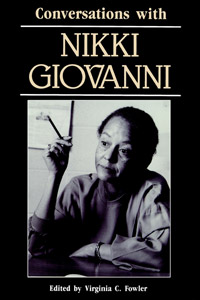
Conversations with Nikki GiovanniConversations with Nikki Giovanni
Edited by Virginia C. Fowler
ISBN: 9780878055876
(c) 1992

The is a collection of interviews with and articles about Nikki Giovanni from 1969 to 1992. The pieces are in chronological order and it’s interesting to see how her views on a host of subjects (writing, poetry, racism, sexism, revolutions, movements etc) shifted over the years. At the same time, the “Nikki” that we “see” is also influenced by the point of view of the interviewer–through the questions they ask and their additional commentary.

It’s hard to pick out highlights, but you absolutely have to read the pieces where Ms. Giovanni is in conversation with older civil rights/black lit icons:
*an excerpt from A Dialogue (1973), where a “young” NG talks with James Baldwin about “the black male” and responsibility
*an excerpt from A Poetic Equation: Conversations Between Nikki Giovanni and Margaret Walker (1974), a “hot” conversation about generational differences in response to violence, individuality vs community responsibility, etc.

I am tempted to pull out quotes–there are some great zingers here (especially in regards to her early 70’s views about the feminist and unisex movements)–but I really think they should be read in context.

Okay, maybe a couple of quotes. This is from a 1983 interview with Claudia Tate where Nikki Giovanni explaining why she doesn’t read her older prose pieces (p 145):

“But I’m very much afraid to be trapped by what I’ve said. I don’t think life is inherently coherent. I thing what Emerson said about consistency being the hobgoblin of little minds is true. The more you reread your prose the more likely your’re going to try to justify what you’ve said.”

“If I never contradict myself then I’m either not not thinking or I’m conciliating positions and, therefore, not growing. There has to be a contradiction.”

~
The Essayist

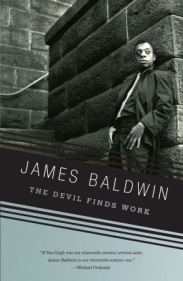
devilfindsworkThe Devil Finds Work
James Baldwin
ISBN: 978-0-307-27595-0
(c) 1976

This is a book length essay in which James Baldwin talks about his relationship with movies/film. It’s personal reflections and autobiographical bits filtered in with observations about movies and, to a smaller degree, theater.

Seeing “classic” movies through the eyes of Baldwin was really eye opening for me. For example, I’d never thought about how a black person who lived through the 40s, 50s and 60s would view the (race fantasies?) In The Heat Of The Night (1967) or Guess Who’s Coming To Dinner (1967). I felt a powerful “yeah!” is the scene where Endicot and Mr. Virgil Tibbs exchange slaps:

But in 1967 would a black audience have rolled their eyes at this? Would the reality of life hinder a suspension of disbelief. Heat and Dinner were written for mainstream audiences, feel good movies about progress. Well meaning, but for Baldwin, missing the mark in so many places…

He talks about Lady Sings The Blues in contrast and comparison to Billy Holiday’s real life–as well as his own adventure as the writer a biographical screenplay in Holiday. Basically, never forget that every biography you see on screen has been crafted for entertainment and not truth.

Another great thing about this book is that it introduced me to several movies that I’d never never heard of. Before the 70’s horror movie with a similar title, there was I Spit On Your Graves (1959). According to Mr. Baldwin, the film version (like most adaptations) veers away from Boris Vian’s 1946 novel–which I’ve put on my reading list.

Let’s have a quote from this one, too. In discussing the the superiority of theater (not the sanitized, Broadway version) over movies (p 35):

“Here [the theater], nothing corroborated any of my fantasies: flesh and blood was being challenged by flesh and blood. It is said that the camera cannot lie, but rarely do we allow it to do anything else, since the camera sees what you point it at: the camera sees what you want it to see. The language of the camera is the language of our dreams.”

~
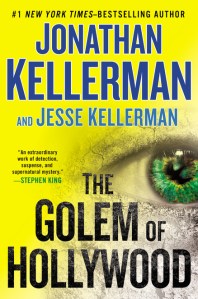
The Golem
The Golem of HollywoodThe Golem of Hollywood
Jonathan Kellerman and Jesse Kellerman
ISBN 9780399162367
Pub Date: 9/16/2014

Picture it: you are a Jewish police detective suddenly assigned to a special, secret division that handles particularly unusual murders. You get to a crime scene and find clues that suggest that this strange, new killer appears to have ties to the Jewish community. The more you delve into the investigation, it becomes clear that this murder is not a singular event. In the midst of the human carnage, could there be a supernatural force for Justice muddying the waters?

This book is over 500 pages but it’s a fast paced and action packed. There’s a likeable but flawed detective, a mysterious woman and an intriguing case that incorporates Jewish culture and mythology.

Don’t know what a Golem is – it’s a man-made creature made of clay created to serve a master. Think of it like Frankenstein but powerful Rabbi and clay–not mad scientist and stitched up body parts. Actually, the concept pre-dates Mary Shelly’s Frankenstein and it’s thought that she was inspired by Golem mythology.

The Baltimore Tape

bmoretape

Cleaned out the car–and look at what I found!

This is a tape that I bought from a dj at “da club” in the 90’s. I labeled it Baltimore because it reminds me of home–specifically, my college years. It was my first taste of freedom–I no longer had a curfew! I had just started dating and trying to figure out how to court girls was confusing, but fun. And where do you find girls who like other girls-a place like Club Bunns.

I’d go out with friends, sit at the bar and try to sound like an adult when I order a non-alcoholic fruit punch. Got to be careful not to stand too close to your girl friends, so a potentially interested person won’t think the two of you are girlfriends. Is she looking at me? Do I look back? Who is that sitting next to her?

But then, that good music would hit and the beat reverberated through everyone and everything. Suddenly, I was just happy to be with my friends and in a whole crowd of folks who were like me.

The Baltimore Tape (contents):
Ten City – Fantasy
Loni Clark – U
Janet Jackson – Because Of Love
CeCe Peniston – Searchin
Juliet Roberts – Caught In The Middle
En Vogue – What Is Love
Whitney Houston – Queen Of The Night
Hidden Agendy ft. Kim Payton – Story of My Life
Taylor Dane – Can’t Get Enough of Your Love Baby
Grace Jones – Sex Drive
Meli’sa Morgan – Still In Love
Sound Waves – Give It Up Girl

or, you can hear them all below