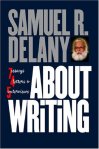
 I read a good chunk of About Writing by Samuel R. Delany on my morning commute. I borrowed the ebook from the library; there are no page numbers for the quotes but I did reference the part of the book it was found in. This is just the tip of the iceberg, but highlighting and bookmarking passages on the iPhone is a trial. I need to buy a physical copy that I can mark up accordingly.
*In talking about the writing process, teaching writing, talent and (or vs) skill, etc – SRD touches on a lot of other topics.
*While I love these quotes and love that they “stand on their own”, I would encourage you to borrow/grab a copy of About Writing and read them in context.
*Also, in one of the letters he criticizes heavily The Bluest Eye. He “went all the way in” on it–made me want to re-read the book with his pov in mind.
An Introduction: Emblems of Talent
“To learn anything worth knowing requires that you learn as well how pathetic you were when you were ignorant of it.”
“A reason knowledge/learning in general is so unpopular with so many people is because very early we all learn there is a phenomenologically unpleasant side to it: to learn anything entails the fact that there is no way to escape learning that you were formerly ignorant, to learn that you were a fool, that you have already lost irretrievable opportunities, that you have made wrong choices, that you were silly and limited. These lessons are not pleasant.”
“Older children tease us for what we con’t know. Teachers condescend to usas they instruct us. (Long ago, they beat us for forgetting.) In the school yard we overhear the third graders talking about how dumb the first graders are. When we reach the third grade, we ourselves contribute to such discussions. Thus most people soon actively desire to stay clear of the whole process, because by the time we are seven or eight we know exactly what the repercussions and reactions will be.”
“We say we are weeping for lost innocence. More truthfully, we are weeping for the lost pleasure of unchallenged ignorance.”
A Black Clock Interview
“Every era’s art is constrained by that era’s concept of vulgarity. The artistic is precisely what is not vulgar. (Until Dante, the language the people actually spoke was outside the precinct of art.) Vast areas of experience always remain outside the literary precincts.”
“More accurately, literature (in its largest meaning) might be seen as the battle of the unsaid to enter the precincts of the articulate.”
A Poetry Project Newsletter Interview: A Silent Interview
Now people desperately love all that wonderful-sounding ambiguity–just as I desperately desired it when I was beaten and confused and exhausted by life and overwork. “I belong to me category; I straddle them all …” It sounds romantic-decadent, but somehow still transcendent. When we pursue such ambiguity, mistakenly we feel it’s a way to escapte social accountability. That we crave such ambiguity is the sign of just how wounding the categories can be or have been. Still, espousing that ambiguity was and is a way of saying: “Not me…I’m above all that, outside of it, not a part of it.”
What I learned is that precisely when one says, “I’m not a part,” one is most trapped by one’s identity, most paralyzed and most limited by the greater society, and that is the sign one has given up, given in; that one is precisely not in a condition of freedom–but of entrapment. Saying, “I am not a part” is very different from saying, “Because I am a part, I will not participate in that manner.” The first is delusion. The second is power–which is inimical to the cry of powerlessness that you quote–and is the other way discourses are changed.
 Tawanna Sullivan